

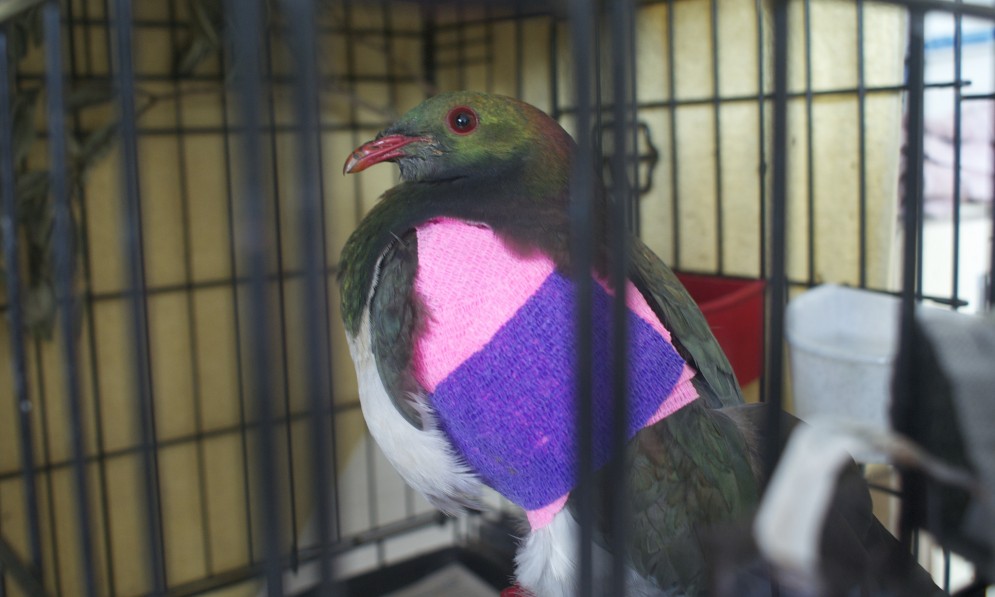
If you find and injured or abandoned bird on Waiheke Island please contact one of the following people.
- Susan Crow (Vets on Waiheke 372-8387)
- SPCA Birdwing Lesley McDougall 372 5222 027 539107
- Forest & Bird Member Judy Coutts 372 5452 021 1676427
If you would like to care for an abandoned bird yourself please see below:
Bird Rescue: Care for Abandoned Birds:
The first 3 to 4 days of having an abandoned bird, usually a fledgling will be crucial. If it is still alive after 4 days it should survive with care.
Day 1:
In between feeds keep it in a warm, dark place like a linen cupboard. Do not give it water separately i.e. down its beak.
Creating a home:
In your small or big cage or box have a perch in one corner - thrushes especially like taking food on perches. If your bird is a thrush make sure the box is quite deep. Cover the bottom with old towel and heaps of paper, or a mixture like pine needles or dried grasses etc. Replace the towels, paper and pine needles when they are dirty.
Scatter leaves and twigs in one part of cage for the bird to play with, as it gets older and to scratch around in.
In the first few days you can also fill a hot water bottle and cover that with a towel and more paper towels and put in box with bird. Fledglings can get cold initially so this helps to keep them warm over night.
During the day you can cover the box with shade cloth and at night it's good to put towels over the box. Make sure air can still get through via small holes at the side. At dusk birds seem to get agitated. When this becomes excessive cover the cage with towel. This helps the bird get to sleep and keeps them warm.
Eventually with thrushes and other worm eaters you can place a dirt box of worms in your cage.
Always have a small saucer of clean water in the cage.
Feeding:
Birds need to keep their crop full. If a baby bird’s crop gets too empty it may not survive. Birds will stop opening their beak if their crop is full.
Birds like thrushes need to have 1-2 tablespoons (tbls) or 4-8 teaspoons (tsp) of following mixture every day. Feed ¾ tsp every 2 hours between 6am and 8pm.
Smaller birds like wax-eyes will only eat about half this amount in a day. Feed ¼ - ½ tsp every hour for wax-eyes or similar sized birds.
Mixture and feeding for blackbird, thrush and other worm eating birds:
If you get fledglings at very early stage - use a basic Bird Rescue mixture to start with
Basic bird rescue mixture:
• 1/2 drop/pinch calcium powder or Bonegrow
• 1 tsp raw egg yolk
• 1 tsp of glucose or sugar water;
• 4-6 tsp of Farex (dry human baby food).
If have to use dropper to feed - the mixture needs to be thin enough to be taken up dropper and squeezed with dropper end right into back of beak like a mother bird would.
After 24 hrs add 1/4 tsp jellimeat, and gradually more jellimeat - up to 1/2 teas to tablespoon over the above mixture.
When feeding very small fledglings with dropper raw egg yolk mixture can get on beak. You will need to wipe beak gently with warm damp tissue if this happens, as bird's nostrils are in beak area and the yolk will set hard.
After a couple of days of successful feeding with thinner mixture (using raw yolk) move to mashed hard-boiled yolk in the feed mixture. Initially feed with small dropper and wash dropper after each feed as gets sticky.
Later move to this mixture:-
Based on making 2 tbls for the day:
• 2 tsp mince (fine cut - topside is best as mixture needs to be fine like regurgitated worm) alternative possibility is jellimeat alone if don’t have mince available
• 1 pinch Bonegrow
• 1 tsp of jellimeat (cat food)
• 1/2 slice brown bread (can be softened first in a bit of warm/hot water so it will mix in mixture to a nice mushy constituency
• 1/2 yolk of hard-boiled egg mashed up (NO WHITE)
Use a short piece of straw. Making sure only one end pokes out of your hand - thus equating one beak. Come towards bird with a bit of mixture (about as big as half a fingernail) on end of straw - heading towards just above the beak. It should open its beak wide for you and then you push the straw and mixture right into the beak going almost to back of beak where you can see tongue - bird should close beak then take food and swallow it into crop. You’ll need to wash the inside of straw once a day because mixture gets caught there.
Store mixture over the cool area on top of your fridge so it is not too cold to feed.
Mixture and feeding for Wax-eyes and other small nectar eating birds:
If you get fledglings at very early stage - use a basic Bird Rescue mixture to start with
Basic bird rescue mixture:
• 1/2 drop/pinch calcium powder or Bonegrow
• 1 tsp raw egg yolk
• 1 tsp of glucose or sugar water;
• 4-6 tsp of Farex (dry human baby food).
If have to use dropper to feed - the mixture needs to be thin enough to be taken up dropper and squeezed with dropper end right into back of beak like a mother bird would.
After 24 hrs add 1/4 tsp jellimeat, and gradually more jellimeat - up to 1/2 teas to tablespoon over the above mixture.
When feeding very small fledglings with dropper raw egg yolk mixture can get on beak. You will need to wipe beak gently with warm damp tissue if this happens, as bird's nostrils are in beak area and the yolk will set hard.
After a couple of days of successful feeding with thinner mixture (using raw yolk) move to mashed hard-boiled yolk in the feed mixture. Initially feed with small dropper and wash dropper after each feed as gets sticky.
After 2-3 days can start adding pulverized fruit e.g. kiwifruit, plum, cherries, banana etc. to above mixture - starting with about 1/2 dessertspoon of blended fruit to 1 tbls of mixture.
Then get some mince and using a blunted toothpick or 'thinned match' get minute amount of mince and dip in above mixture and feed in same way to dropper feeding. As days go by and bird is bigger the tiny pieces of mince can get bigger and the birds take these more readily. This mince is equivalent to the small insects nectar-eating birds bring back to their young.
After more feathering e.g. tail feather starting to develop - leave small pieces of fruit in the cage and eventually the birds will start pecking at these.
When they are fully feathered, flying and able to eat for themselves they are ready for release.
Tuis:
A fledgling tui tends to be black with 3 white stripes on the wings and a yellow beak. It has a huge mouth. They can be feed a mixture of farex (baby food) and tinned baby fruit mixed with bit of honey or sugar water
Behavior and Release:
Birds sleep at night. They don't seem to mind a quiet talking to and they get use to sound of your voice. To help with bonding you can use an Audubon birdcall to indicate when you are going to you’re your bird.
Remember a thrush can hop quite fast and if at the stage of flapping wings it will try to escape the box as it keeps growing.
Keep in box as it will make a mess - or a small holed cage.
A thrush is not ready for releasing until its tail feathers are as long as your index finger or up to end of second knuckle at least which is about four weeks.
In last couple of weeks before release - you need to start feeding live worms, to worm-eating birds like thrushes/blackbirds.
Firstly for about a week by your fingers or tweezers.
At first worms can't be too big or need chopping in half if they are more than 3-5 cm.
Finally you can get a dirt tray and cover live worms with dirt in it and encourage the bird to start scratching for own food.
Start hand feeding less. It will protest of course but try to persist. You may need more than one attempt if bird doesn’t start scratching straight away. The bird may come back to the cage at your release site for a feed. You may have to check over the next few days to check that the bird is scratching the ground.
Mother thrushes and blackbirds tend to just abandon their babies when the tail feathers are long enough and they have started finding and eating worms. You can be a bit more careful if you like to ensure they can fend for themselves.
