
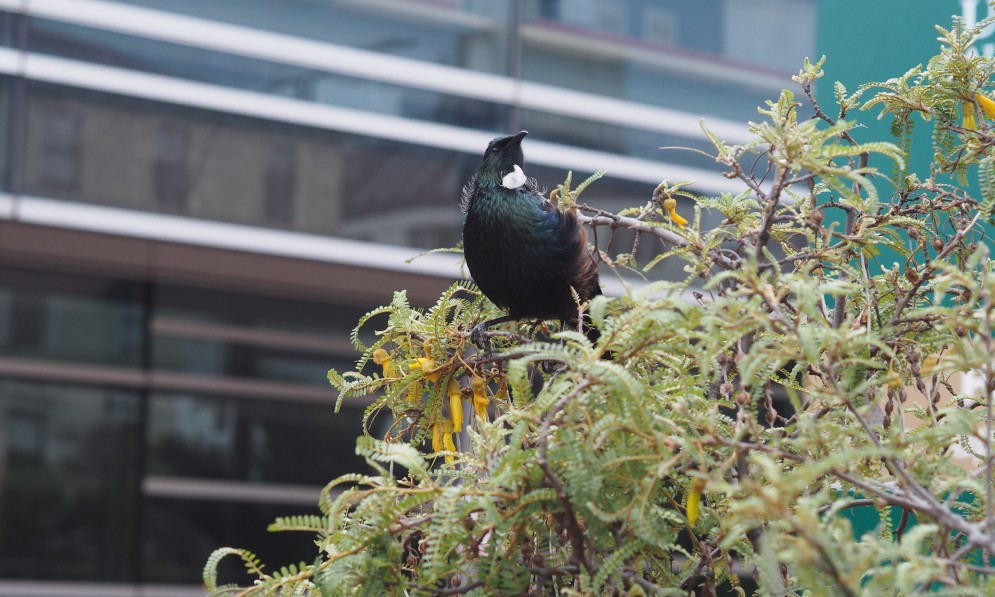
The Wellington tūī that helped inspire Wild Cities. Image Chris Fitch
Suffering from self-diagnosed "nature deficient disorder" Chris Fitch set out on a global journey to discover the myriad ways citizens are greening their urban spaces and reaping multiple wellbeing benefits.
Forest & Bird Magazine
A version of this story was first published in the Summer 2025 issue of Forest & Bird magazine.
It all started with a tūī. I’d been in Wellington for a month, interviewing people and exploring ideas for a book I was thinking of writing about nature in urban spaces. Many Wellingtonians had shared their personal experiences with me, of the city’s dramatic transformation from a place bereft of native birds, to one where previously rare species had become everyday sights. But despite the knowledge I was accumulating, I was still unconvinced. I still didn’t quite feel it.
On my day of departure, I was dragging a suitcase down Bunny Street, heading to the train station to board an early morning bus heading north. Movement, in my peripheral vision. I stopped, looked around, and spotted the bird that had most infatuated me during my research – the iridescent tūī. It swooped down from the sky and landed in a nearby kōwhai tree.
Dropping my bags, I pulled out my camera, edged forward, and lined up the shot. The resulting photo showed a tūī with its chest proudly puffed out, white tuft flapping. Crucially, with the large windows of a modern city building clearly visible in the background.
Finally, I felt it. The thrill of discovering wildness in a city. I wanted to share this experience, to write something that celebrated these extraordinary everyday moments with nature in the places where people live, and the stories that had made them possible.
My initial inspiration for Wild Cities had started with several years of dissatisfaction with London living. There are obvious benefits to such major cities – the energy, the creativity, the connections, the convenience. But there were also those quietly corrosive elements that I struggled to find comfortable – the greyness, the noise, the artificiality.
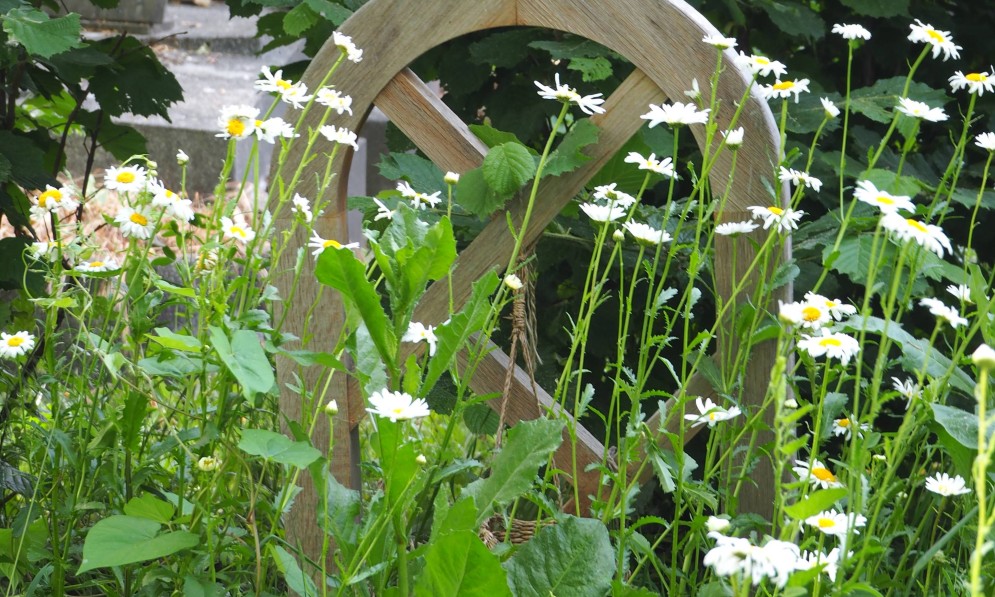
Biodiversity is allowed to thrive in Paris’s ecological cemeteries. Image Chris Fitch
It didn’t help that the view from my bedroom window looked out over the top of a large shopping centre, a desolate space of metal ladders, guard rails, ventilation pipes, and air-conditioning units. Not a shred of greenery in sight. The absence of meaningful ecology in life weighed heavily on me, even if I didn’t entirely understand why.
And I strongly suspect I wasn’t alone.
Cities don’t come out of nowhere. They’re built on landscapes. Before there were cities, there were once swamps, forests, and deserts. Winding rivers, arching bays, sloping valleys. Nature, rich in biodiversity, an unimaginable variety of lifeforms.
These natural features are almost irrelevant to the daily life of the modern city dweller, replaced by roads and buildings, disappearing beneath concrete and asphalt.
Today’s average human needs to travel almost 10km before they find themselves in an undeveloped location, and considerably further in heavily urbanised regions like Western Europe and North America.
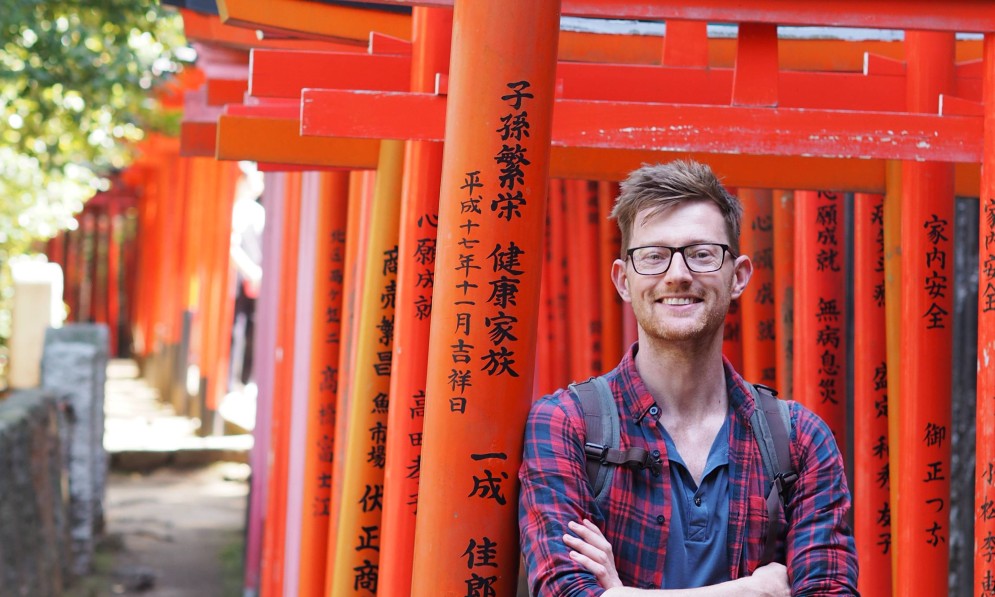
Chris Fitch at a Shinto shrine in Tokyo. Image supplied
The spread of cities means that we as a species are getting further and further away from natural spaces with each year that passes.
This means each new generation now experiences, and accepts, a more diminished version of what they consider to be a normal amount of nature, a phenomenon known as “shifting baseline syndrome”.
Nature is vanishing, but we don’t notice, because we accept the increasingly sterilised world we were born into as normal. At the extreme, there are now billions of people worldwide who, unlike their grandparents, or other ancestors, are almost entirely cut off from nature.
And that’s a problem, as we are inherently nature-loving creatures. Humans evolved within nature, it’s something we are instinctively attracted to.
The concept of “biophilia” – human attraction towards life, in whatever form it appears – was first conceived around the turn of the twentieth century, later popularised by the legendary American ecologist Edward Osborne “EO” Wilson, often called the “father of biodiversity”.
Wilson argued that biophilia, the innate love of nature, isn’t something humans learn – we are born with it. It’s a quality that all humans crave, regardless of our individual life experiences.
All of us, deep down, have that same desire to connect with the natural world, hard-wired into our genes. This is biophilia. This is what we miss out on when we live in cities.

Light emissions are heavily regulated to protect Flagstaff’s starry night skies. Image Chris Fitch
The consequences of ignoring biophilia, of living a nature deficient life, can be highly detrimental. There’s a fancy term that people use: “nature deficit disorder”. It’s the idea that modern humans, and especially children, are suffering psychological problems because of our detachment from nature.
Personally, I really felt this disconnection. My self-diagnosed nature deficit disorder manifested itself as a low-level stress, a heavy anxiety trapped inside my chest. I developed an indecisive personality, torn between different potential futures.
Am I a city person or a nature person? Do I like skyscrapers or forests? Tarmac or dirt? Would I like to disappear into the relative anonymity of a huge city or live in glorious remote isolation?
And the answer to these questions was basically ... yes. Yes to all. Yes to nature, and yes to cities. Ultimately, I asked myself, is it really necessary to choose between them?
This became my focus. Could I find, somewhere in the world, a city that balances the social and cultural lifestyle that makes cities great with the ecological biophilic conditions that humans crave? Does such a place exist? If I can’t find one perfect city, maybe inspiring stories from many different cities would be just as good or even better?
And so I travelled, chasing fascinating stories from continent to continent. I discovered guerrilla gardens, rooftop forests, and giant urban river rodents. I ate leaves growing wild by the side of the road, followed the legacy of an eccentric nineteenth-century alien chaser, and confronted my own inevitable mortality. Most importantly, I found nature, even within the city.
And I’ve got that tūī to thank for it.
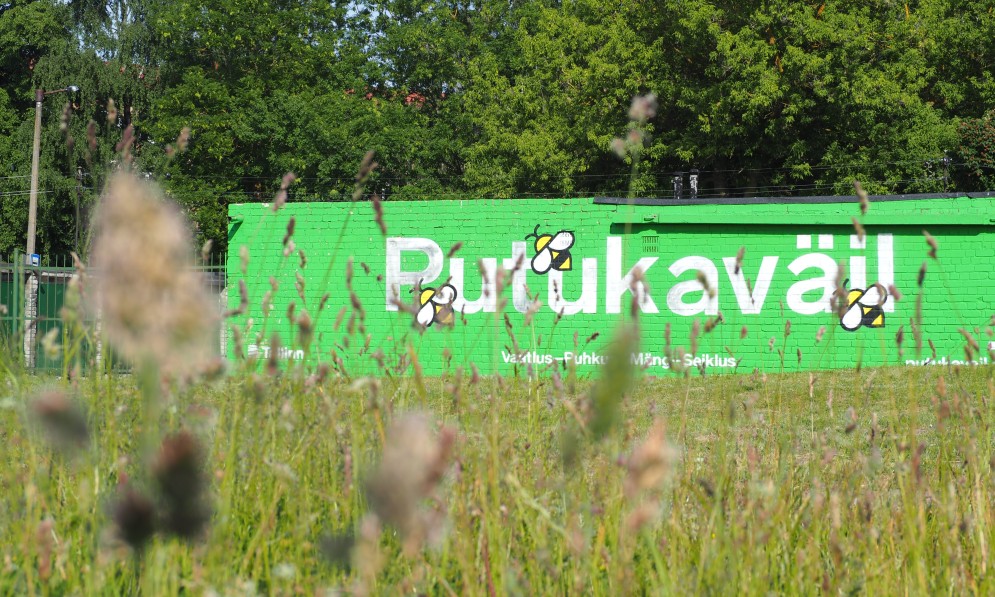
The Estonian city of Tallinn transformed a disused railway corridor into Putukaväil a “pollinator highway” providing food for native bees, butterflies, and other insects. Image Chris Fitch