
Youth Creature Feature [February 2026]

New year, new schnozz, and this one is attached to the Aussie-born glam rock dance-master of the wetland.
By Jasmine Starr
If you regularly read these Creature Features, you’ll know I’m a sucker for a schnozz. Be it weevils, moles, or the red-lipped batfish, a splendid snoot never fails to capture my love.
Today, I’m talking about the Royal Spoonbill, or kōtuku ngutupapa.
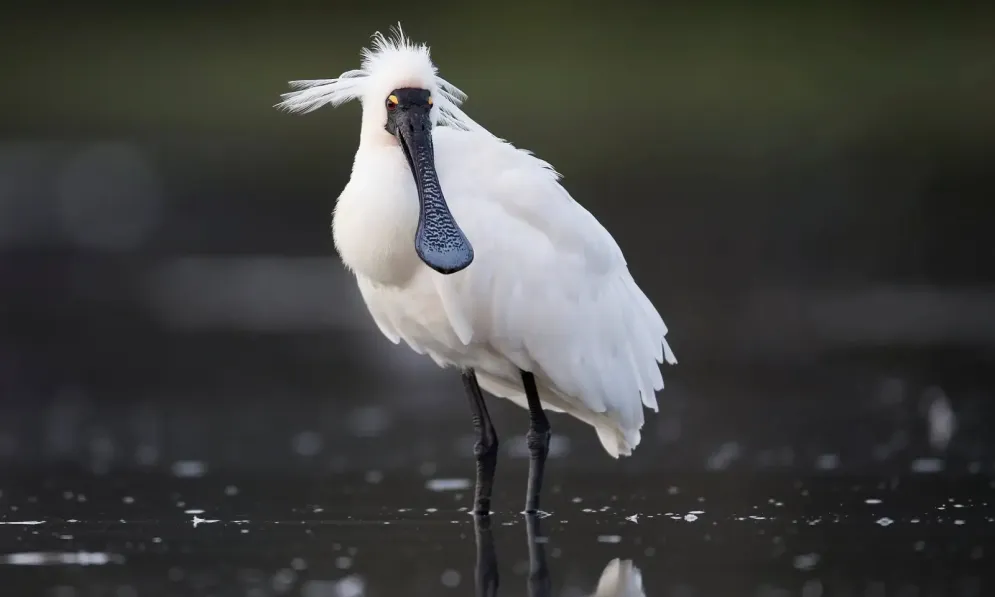
You’re welcome. Credit: JJ Harrison, CC BY-SA 4.0.
Alongside “what?”, “is that real?”, and “are they single?”, I’m sure you’re wondering why spoonbills have such a strangely shaped bill. Well, if you’re tempted to poke fun, I ask you one thing: can your nose vacuum up crabs?
When waved back and forth, their spoon-like bill creates small swirling whirlpools in the water around it. This effect, called a “bill-tip vortex”, sucks invertebrates out of the silt and pulls them in a “water column” towards the spoonbill’s mouth. The creatures swim around perplexedly, triggering the spoonbill’s vibration detectors, and are scooped up in one big gulp.
After a spoonbill’s swishing has captured a meal, they’ll tilt their beak to the sky, letting the prey slide right down their throat. It’s a mesmerising pattern. Swooshing and gulping and stepping and swooshing again, over and over, until they’re finally full.
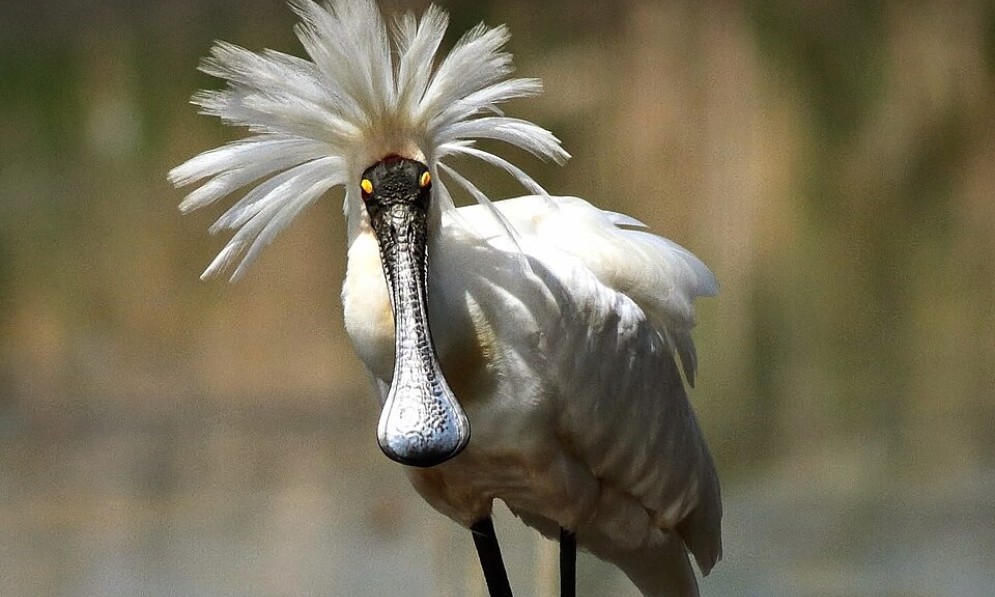
Her Highness the Royal Spoonbill. Credit: Wayne Butterworth, CC BY 4.0. Image has been cropped.
With a crown of big floppy feathers and striking yellow eyeshadow, spoonbills are the bird equivalent of glam rock. But they’re not so bedazzled year-round. Both genders don this apparel during mating season, growing a dapper patch of mustard on their chest and head feathers up to 20cm long. The rest of the year, they’re a close-cropped black & white!
To signal their interest in a mate, spoonbills extend their neck, open their bill, flip up their feather crown, and flap their wings rapidly whilst madly jumping around. As an awkward, gangly fellow myself who likes plodding around in shallow water and has no idea how to flirt, I feel a deep kinship with these creatures. Next time I go out dancing, I’m absolutely channeling the spoonbill.
Spoonbills fly with their neck stretched forward, legs protruding straight down at a right angle. In some photographs, they’re almost supernatural. A wraith gliding through the mist. Scratch that: They look like you’ve attached angel wings to a medieval worm, Fiji-mermaid-style.
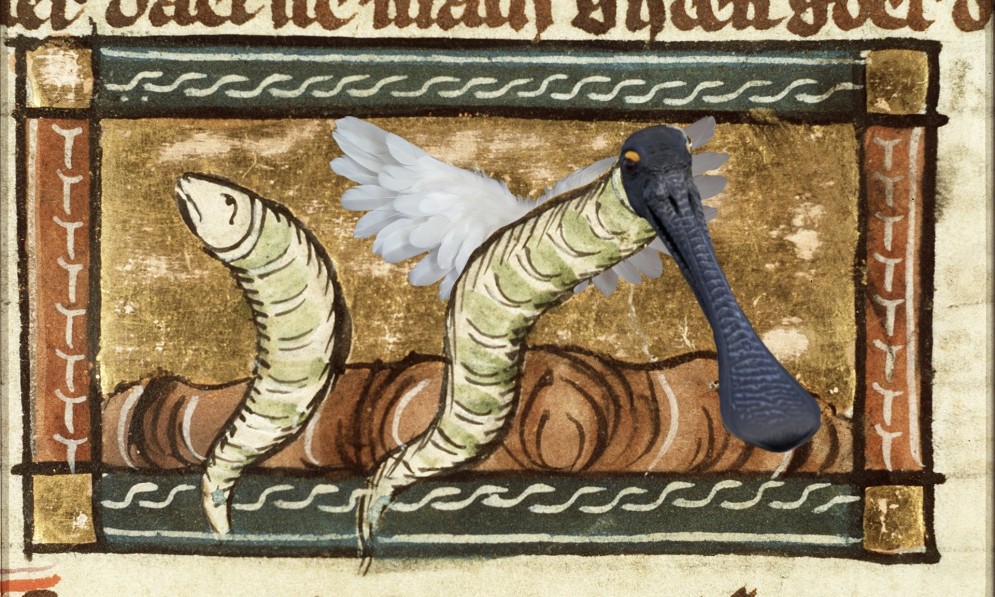
You see my vision. You understand. Credit: JJ Harrison, CC BY-SA 4.0; Needpix, CC0 1.0; Maerlant, c. 1340.
Australian in origin, spoonbills flapped over to Aotearoa by their own volition. First arriving in the mid-1800s, new birds consistently flew across the ditch, buoying the population to breeding size. Oddly enough, their Australian counterparts don’t tend to travel. Why our spoonbills made the 4,000-kilometre journey is anyone’s guess!
Spoonbills still hold strong in their Australian homeland — particularly across the east coast, and Darwin for some reason. While there are no established populations, they sometimes vacation in nearby islands like Papua New Guinea and Timor-Leste. Royal Spoonbills exist all across Aotearoa’s estuaries, with strongholds at Whitirea Park, Waimanu, Lake Ellesmere, Southshore, and Dunedin.
I was fortunate enough to see some spoonbills up at Manawatū Estuary last year. I have never in person seen an animal so brilliantly white, or so beautifully black, and the contrast between the two is beguiling. You can’t help but stare.
If you live near any regular spoonbill sightings, I strongly urge you to take a look. There are few things that simply cannot be described, but a spoonbill grooming themselves is one of them. Their bill is so long, they have to stretch their neck backwards. They move their head stiffly around, tilting the base of their neck at increasingly unwieldy angles. It’s breathtaking.
So, if you’ve ever felt like an outcast — whether it’s because of your awkwardness, your difficulty grooming, or the huge shovelesque appendage protruding from your face — consider signing this petition to oppose mining at our beautiful Denniston. Help us set a precedent for protecting wild spaces, so Aotearoa’s creatures can bedazzle hearts for generations to come!
Youth Creature Feature is your monthly dose of Aotearoa New Zealand's wacky, whimsical, and wonderful native and endemic species.
Want to get in touch?
Maybe you'd like us to write for you. Or you'd like to write for us?
Contact: Forest & Bird Youth Editors