

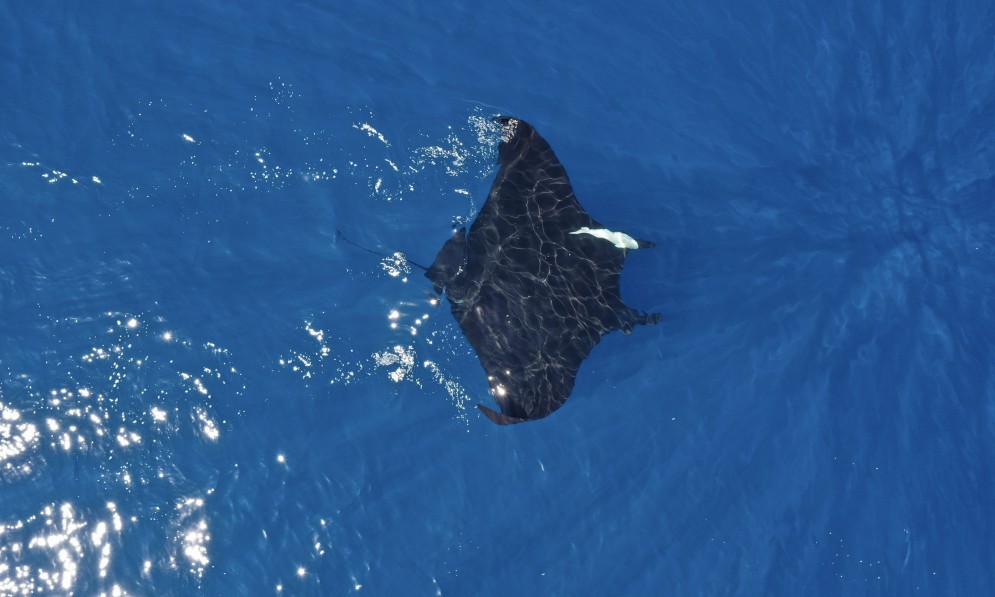
Giant oceanic manta ray. Image Lydia Green
Unlocking the secret lives of Aotearoa New Zealand’s oceanic manta rays. By Lydia Green
Forest & Bird magazine
A version of this story was first published in the Spring 2025 issue of Forest & Bird magazine.
Te whai rahi the giant oceanic manta ray glides through the water, its large wing like pectoral fins flapping and undulating, propelling the huge animal efficiently and gracefully through the water.
Mobula birostris is the largest ray in the world, growing up to 7m across (four times the height of me) and weighing up to two tonnes. They spend most of their lives far from land, moving with the currents in search of food in tropical and temperate waters.
They are one of a rare group of animals with a worldwide distribution in both northern and southern hemispheres. They are commercially fished in some places (their gill plates are used in traditional Asian medicine) and protected in others, including in Aotearoa New Zealand’s waters.
Unfortunately, over the last few decades, commercial fishing and bycatch deaths have had a massive impact on the species, leading to their global threat classification of “Endangered and in decline” on the IUCN Red List.
The southernmost populations live off Peru, South Africa, and New Zealand. They are often found near offshore oceanic islands, including Tīkapa Moana, Te Moananui-o-toi the Hauraki Gulf, although until recently little was known about this elusive population.
Lack of data is a big threat to their wellbeing. This is where Manta Watch New Zealand comes in. We are a small charitable trust dedicated to uncovering the many mysteries surrounding Aotearoa’s special te whai rahi population.
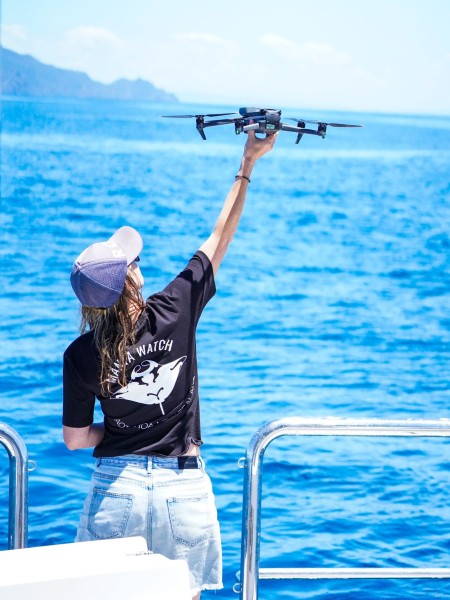
Lydia Green launches a manta-tracking drone. Image Rebecca Pratt
In 2020, we set out to answer some key questions, including how and why mantas use New Zealand waters and the kinds of threats they are exposed to during their day-to day lives.
This project has led to some exciting discoveries. It turns out that New Zealand’s manta rays dive deeper, travel further, and go into colder water than any other manta population in the world.
How did we discover this? Our dedicated Manta Watch NZ research team spent the past five years tracking manta rays in Aotearoa waters, from Northland to the Bay of Plenty. We gathered lots of useful new data in the form of high-quality videos via aerial drones and underwater cameras.
We also collected a host of vital demographic data, including gender, size, injuries, pregnancy, as well as behaviour. The markings on a manta ray’s belly are unique to that individual and remain unchanged over its lifetime. So we’ve been working to identify individual manta rays by collecting their photo IDs.
This means researchers can track individuals over time and gain valuable insights into how a population is structured, as well as estimate its size.
Researching a highly mobile marine species that doesn’t need to come to the surface can be tricky. The project’s research efforts are supplemented by a national manta network – aka hundreds of citizen scientists who submit sightings to the project. We developed a Manta Watch NZ app so people can record sightings, key facts, and videos and images.
This collective manta mahi provided invaluable insight into seasonal distributions and habitat use. Moreover, real-time and historic sightings helped the team focus their manta survey efforts, increasing overall encounter success.
Satellite tagging has also been a vital tool in accelerating our understanding of how mantas are using their habitat, horizontally and vertically. They exhibit two distinct modes – feeding and migrating.
Our inshore waters serve as important seasonal feeding grounds. Individuals have been tracked moving between regions in search of kai, spending most of their time within the top 5m and feeding on dense swarms of krill.
Tagging data has also confirmed that at least a proportion of Aotearoa’s manta population seasonally migrate out of our waters into the wider Southwest Pacific. More than 70% of mantas tagged left New Zealand waters around late summer and early autumn, heading towards Fiji and Tonga.
While on the move, Aotearoa’s mantas have redefined what we previously thought the species was capable of doing – they dive deeper (1400m), travel further (4500km in 52 days), and venture into colder water (3.5°C) than any other manta population has been shown to do!
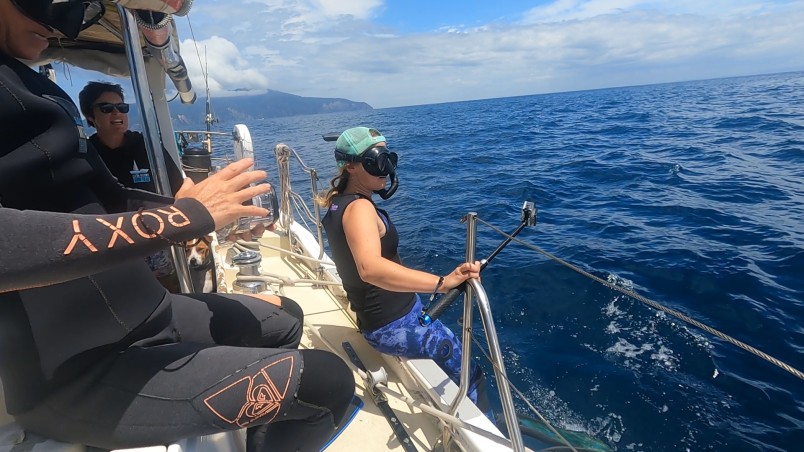
Getting ready to survey manta rays in the Hauraki Gulf. Image Rebecca Pratt
CONSERVATION WINS
The data and knowledge gains achieved through our Manta Watch NZ project have enabled the New Zealand Threat Classification Status for oceanic manta rays to be upgraded from Data Deficient to Nationally Vulnerable.
We also gained Important Shark and Ray Area status for a total of 445,546.4km² ocean habitat.
This includes the Hauraki Gulf Marine Park as an important feeding area and the newly defined migratory corridor between New Zealand, Fiji, and Tonga as an important movement area.
These two wins set the foundation for greater species and ecosystem conservation management in New Zealand and the Pacific. By establishing greater protections for our oceanic manta rays, entire marine ecosystems will benefit.
Our next steps will be studying the population’s genetics and potential nursery areas, and investigating the threats our mantas face when migrating out of New Zealand’s Exclusive Economic Zone into the high seas.
Manta Watch NZ’s research partners include Conservation International Aotearoa, the University of Auckland, the Department of Conservation, and the Tindall Research Charitable Trust. Our primary funders are Whakatupu Aotearoa Foundation, Live Ocean Foundation, Manta Trust, and Pub Charity Ltd.
FASCINATING FACTS
Giant oceanic manta rays have only been protected in New Zealand waters since 2011. It is illegal to hunt, kill, or harm them. If caught by mistake, they must be released alive and unharmed.
Te whai rahi are essentially flat sharks and share key attributes – for example, they have dermal denticles (tiny teeth) instead of scales and a light flexible skeleton made of cartilage instead of bone. They can only travel forward and cannot reverse out of fishing nets.
Oceanic manta rays have the largest brain of any fish and also one of the most conservative life histories of all shark and ray species. They are slow growing, long lived (at least 40 years), and late to reach sexual maturity. They typically only give birth to one pup at a time, after an extensive 12.5-month gestation period.
Like all marine life, te whai rahi is impacted by climate change. Changes in sea surface temperatures and other climate-related phenomena, such as El Niño, can affect their distribution, food supply, and potentially their survival.
Put that all together, and you have yourself a highly vulnerable species whose populations really cannot cope with any form of fishing exploitation.
Lydia Green is the founder and project director of Manta Watch New Zealand.