

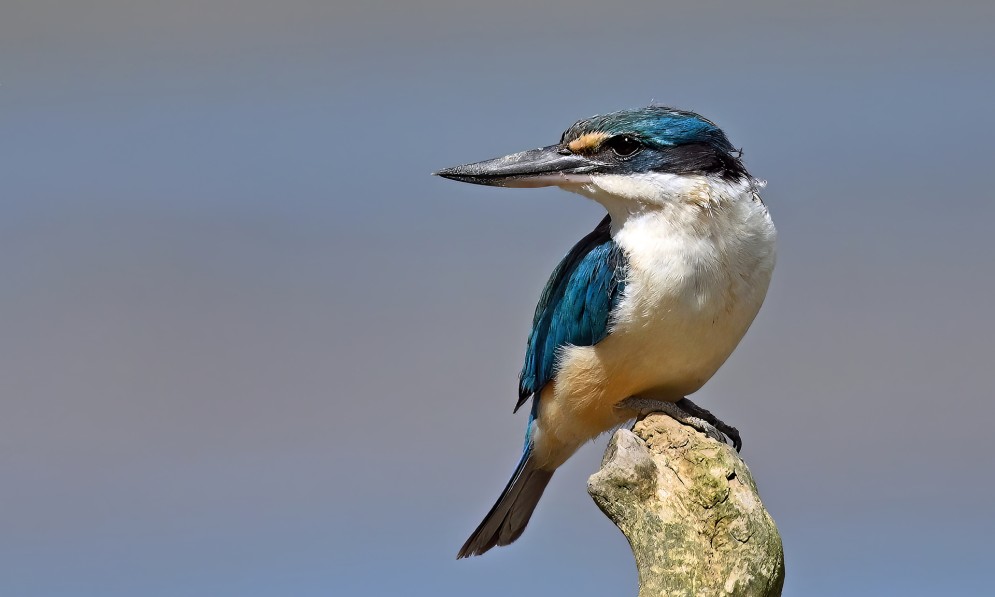
Kōtare sacred kingfisher. Image Maurice Summerfield
A flash of iridescent blue brightens up Ann Graeme's day as she observe kōtare sacred kingfishers in her garden.
Forest & Bird Magazine
A version of this story was first published in the Summer 2025 issue of Forest & Bird magazine.
I frown at introduced Phoenix canariensis, the Canary Island palm, in my home town. Their ragged, alien mopheads dominate the urban skyline, their dangerously spiky fronds litter the ground, and their seedlings invade our native forest.
It felt like a betrayal when our kōtare sacred kingfisher family abandoned the bank where they had always nested and chose new digs in the phoenix palm over the fence.
Despite the disloyalty, it is good that kōtare, our native kingfishers, have adapted to Aotearoa's urban landscape and are commonly seen in many towns and cities.
Besides places to nest, they need vantage points to perch on, to spot and ambush prey, and our power poles and lines add extra opportunities to the traditional tree branch lookout.
Māori understood kōtare well. They admired the patience and vigilance of the sacred kingfisher at its look-out – qualities essential in a trustworthy sentry. They gave the name kōtare to the elevated platform in a pā hillfort where a sentry would stand.
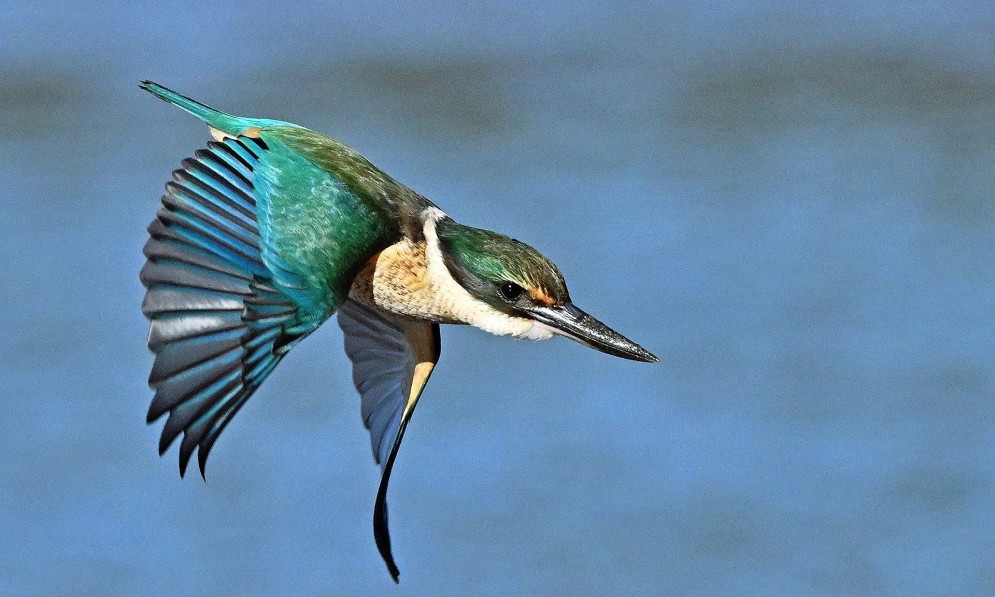
Kōtare sacred kingfisher. Image Maurice Summerfield
As I write this, the kōtare I can see out of my window is perching high in a pūriri tree in my Tauranga garden.
Patiently he waits, scanning the ground below, then down he streaks, seizes a skink and batters it to death. Hopefully, it was one of the increasing number of introduced pest skinks, known as rainbow or "plague skinks".
He flies away with the limp body in his beak, presumably to the hole in the palm tree where his hungry chicks are waiting.
The chicks have been grizzling quietly – but quite audibly. As their parent approaches, their growling rises to a crescendo as they jostle at the nest hole. Briefly, the adult bird grasps the margins of the hole, thrusts the skink into a waiting beak, and flies away.
There will be silence for a while, then the grizzling will start again until the mother bird arrives with more kai. She might be carrying a beetle, for the menu is varied. Or it could be an earthworm, wasp, cicada, crab, even an unwary goldfish!
The chicks' behaviour indicates they are approaching fledging, some 26 days after they hatched. Soon they will leave the nest hole, but their parents will keep feeding them for a week or more until they are practised at hunting for themselves.
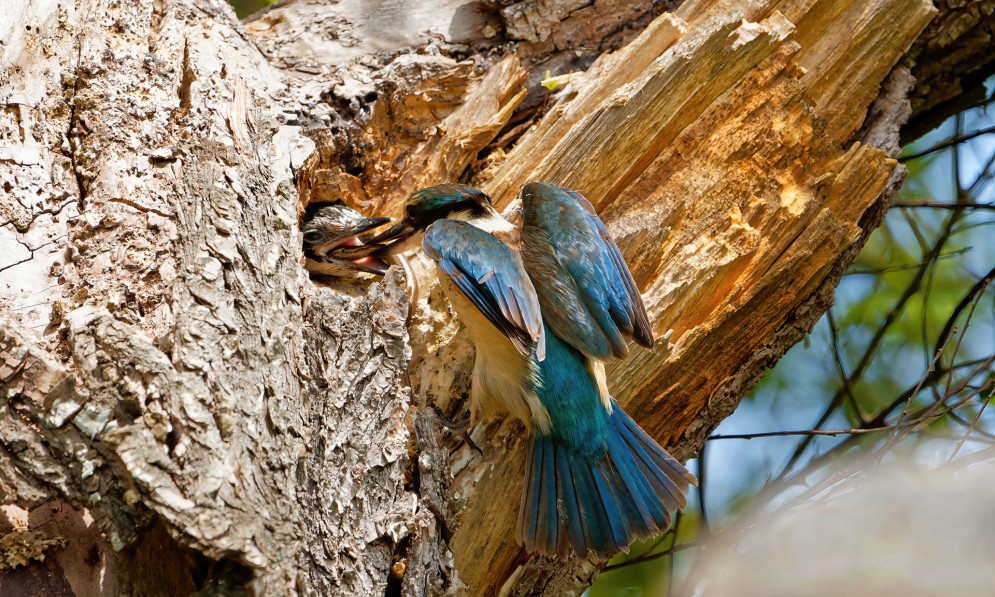
Kōtare feeding a skink to its brood. Image Dan Dirks
Kōtare nest in holes that they dig in clay banks or in dead, rotting tree trunks (or in phoenix palms). Both mates take part in choosing and digging a new tunnel.
The technique is simple. Like blue-feathered arrows, each bird flies headlong, bill outstretched, into the clay or soft wood until enough material is dislodged to create a ledge to stand on. Then the digging can continue until a tunnel has been made, sloping gently uphill to keep out the rain and ending in a nest chamber.
There the female will lay four or five white eggs – unadorned because eggs in holes don't need camouflage. She will do most of the incubating, but her mate will take some turns during the 20 to 21 days it will take the eggs to hatch.
Living in town is not without its dangers. Domestic cats kill kōtare and so do collisions with windows. This second risk can be averted with bird-scaring stickers, visible to birds but largely invisible to us. It is worthwhile trying to minimise the fatalities, if only so we can continue to admire them in our gardens.
How lucky we are to have these birds living in our towns and cities. Look up and you may find a kōtare perched above your head, its brilliant turquoise-blue to emerald-green plumage shimmering in the sunlight.
Halcyon birds
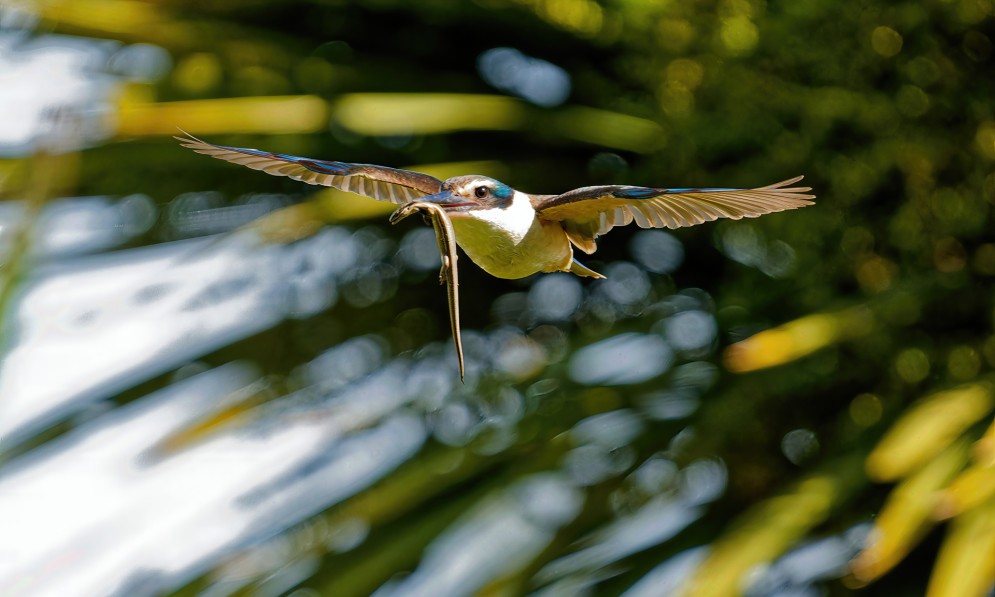
Kingfisher with a skink. Image Dan Dirks
About 120 species of kingfishers live in more than 100 countries worldwide. They are found on every continent except Antarctica, making them truly global birds.
Aotearoa New Zealand's kōtare has the specific name of Todiramphus sanctus so it is also called the sacred kingfisher, and it belongs to the family of kingfishers called Halcyonidae.
This family name is derived from an ancient myth. The Greeks and Romans could not find kingfisher nests in banks or trees, and they observed that in mid-winter there was about 14 days of calm weather in the rough seas of the Mediterranean.
This gave rise to the story that the kingfisher, the "halcyon bird", quietened the waves while it was nesting on the sea. In the period of calm it must have woven its floating nest, laid its eggs, and reared its young.
How could the Greeks make such a mistake? They did not know that their kingfisher was a migratory species. It only spent the winter around the Mediterranean and then flew south in spring to nest and breed in Africa.
The "nests" on the sea were likely floating driftwood and seaweed. We now use the phrase "halcyon days" to mean a peaceful time.
In Aotearoa, our sacred kōtare does not migrate, although in winter, when prey gets scarce, birds may move from the forest to an estuary, where crabs are plentiful. Power lines across the mudflats make ideal perches.
Hardy, adaptable, and beautiful, we should celebrate kōtare the kingfisher, who have carved out a niche in our urban environment.